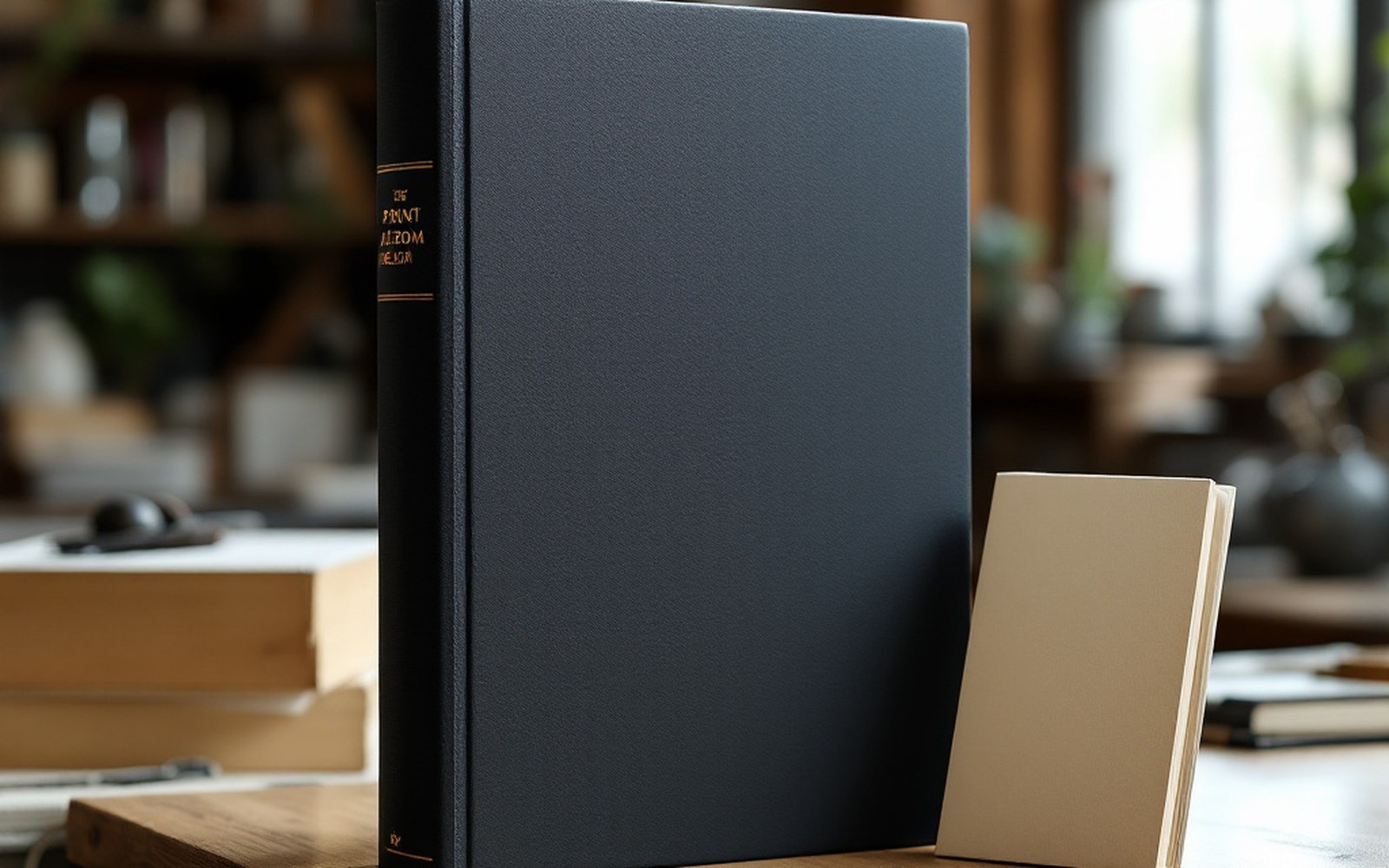
Roughly A4, upright
The European album is a specific physical object: hardbound, roughly A4 in size, and almost always forty-eight pages. The format is not neutral — it shapes what gets made.
A Sheet Counted Out in Signatures
The album — bande dessinée album, to give it its full name — is built from signatures, folded and gathered sections of printed sheet. A standard signature in the European trade folds to sixteen pages; three signatures gives forty-eight, and forty-eight pages became the norm not because editors decreed it but because the arithmetic of the press made it the cheapest complete unit. Add a cover board, glue the spine, trim the edges: you have an object that stands upright on a shelf and does not curl or yellow the way a newsstand pamphlet does.
The trim size hovers around 297 × 220 mm — A4 in portrait orientation, or close enough that the term is used loosely in the trade. Casterman, the Tournai publisher that produced Hergé's Tintin albums from the 1930s onward, settled the proportions early; Dupuis, working from Marcinelle, used similar dimensions for the Spirou material it collected from its weekly magazine. Neither house invented the format from scratch, but both standardised it in practice, and the field followed.

On the record
Dimensions and structure
- 01Standard album trim size: approximately 297 × 220 mm (A4 portrait)
- 02Standard page count: 48 pages, derived from three 16-page signatures
- 03Cover: hardbound board, glued spine, trimmed edges
What the Shape Decides
At roughly A4 and upright, the page area is generous. An artist drawing for the album format works at a scale that allows wide panels — panoramic establishing shots, crowd scenes, architectural detail — in ways the narrower American pamphlet page rarely accommodates. The aspect ratio also suits the three-tier grid, with horizontal panels stacked in rows, though many artists working in the album tradition have extended panels across full tiers or broken the grid altogether precisely because the area allows it.
The hardbound cover changes the economics of distribution. A pamphlet is returnable: the newsagent strips the cover, sends it back as proof of unsold stock, and receives credit. An album sits in a bookshop and is treated as a book — bought by the retailer on the same terms as any other book, and expected to remain in print across multiple years rather than being replaced the following month. The Bibliothèque nationale de France receives albums under legal deposit in the same category as any other published book, which reflects how the format has always been legally classified in France.
The trim size hovers around 297 × 220 mm — A4 in portrait orientation, or close enough that the term is used loosely in the trade.

Serialisation feeds the format. A story runs in weekly instalments in a magazine — Tintin, Spirou, Pilote — and the album collects those pages once the story is complete. This means the forty-eight-page count is also a narrative unit: a completed adventure, packaged and sold as a durable object. The original magazine pages are sometimes reformatted slightly, with colour re-separated for the higher production standards of the album printing, but the page count itself is usually preserved, because the story was paced to fit it.
Why Format Is Argument
Format is always an argument about what comics are for. The American pamphlet positioned comics as disposable monthly entertainment, printed on newsprint with cheap inks and wide margins for handling. The European album positioned comics as literature worth shelving alongside illustrated books. This is not sentiment: it determined which retail environments would stock the material, which libraries would catalogue it, and which readers would consider it. When French and Belgian publishers began serious export to North American markets in the late twentieth century, the format came with them, and the graphic novel — a term English-language publishers adopted for collected, hardbound editions — owed a visible structural debt to the album template, even where no one in the room acknowledged it.
On the record
Chronology
- 011930s onward: Casterman establishes Tintin album format at roughly A4
- 02Same period: Dupuis sets comparable dimensions for Spirou collections
- 03Late twentieth century: hardbound album template influences English-language graphic novel format
The A4 upright page is, in this sense, an argument made in cardboard and ink: that the strip deserves a spine, a shelf position, and the kind of reader who returns to it.
Named in this entry
People and houses
Cartoonist, 1907–1983
Hergé
His albums at Casterman in Tournai set the format other album houses matched.